Carter Law Group
  • Home
  • Let’s Meet
    • Amy Carter, Managing Shareholder
    • Heather Davis, Partner & Chief Operating Officer
    • Hon. Erin Nowell, Of Counsel
    • Kassi Yukevich, Senior Attorney
    • Tracy Pace, Paralegal
    • Kyndal Hetmer, Paralegal
    • TaNia Robinson, Intake Specialist
    • Ethan Green, Legal Technology and Automation Assistant
  • Areas Of Expertises
    • Personal Injury
      • Product Liability
      • Premises Liability
      • Sexual Assault
      • Sex Trafficking
      • Sex Crimes by Massage Therapists
      • Sexual Crimes on Campus and in Campus Organizations
      • Sexual Crimes in Organized Sports
      • Sex Crimes in Religious Organizations
      • Sexual Abuse
    • Employment Discrimination
      • Age Discrimination
      • Disability Discrimination
      • Gender Discrimination
      • LGTBQIA+ Discrimination
      • National Origin Discrimination
      • Racial Discrimination
      • Religious Discrimination
      • Sexual Harassment
  • Results
  • Testimonials
  • Community Involvement
  • Education and Resources
    • Products Liability
    • Product Recalls
    • Sexual Assault
    • Silicosis
    • The Legal Process 101
    • Employment Discrimination
    • Areas Served
      • Collin County
        • Allen
        • Plano
        • Frisco
        • Addison
        • Carrollton
        • The Colony
      • Dallas County
        • Dallas
        • Irving
        • Mesquite
        • Richardson
        • Farmers Branch
        • Garland
        • Carrollton
        • Addison
        • Bishop Arts District
        • Oak Cliff
        • Kessler
        • Trinity Groves
      • Grayson County
        • Denison
        • Sherman
      • Johnson County
        • Burleson
        • Cleburne
      • Tarrant County
        • Fort Worth
        • Arlington
        • Southlake
        • Grapevine
        • Mid-Cities
      • Kaufman County
      • Parker County
  • Fight Like A Mother: The Blog
    • Press
  • Contact Us
    • Discrimination Intake Questionnaire
  • Menu Menu
Amy Carter

Texas Sues HIPPA For Protecting Abortion Medical Records

October 9, 2024/in Current Litigation, Uncategorized/by Amy Carter

In September this year, Texas, that is, Ken Paxton, sued the Federal Health and Human Services (HHS) Department over a new bill that shields medical records of women who go out of state for abortion procedures from state investigators. Speaking as a mother and a legal defender of women, families and children, this lawsuit converges on the rights of women and has dangerous implications for the privacy and freedom of the general public. 
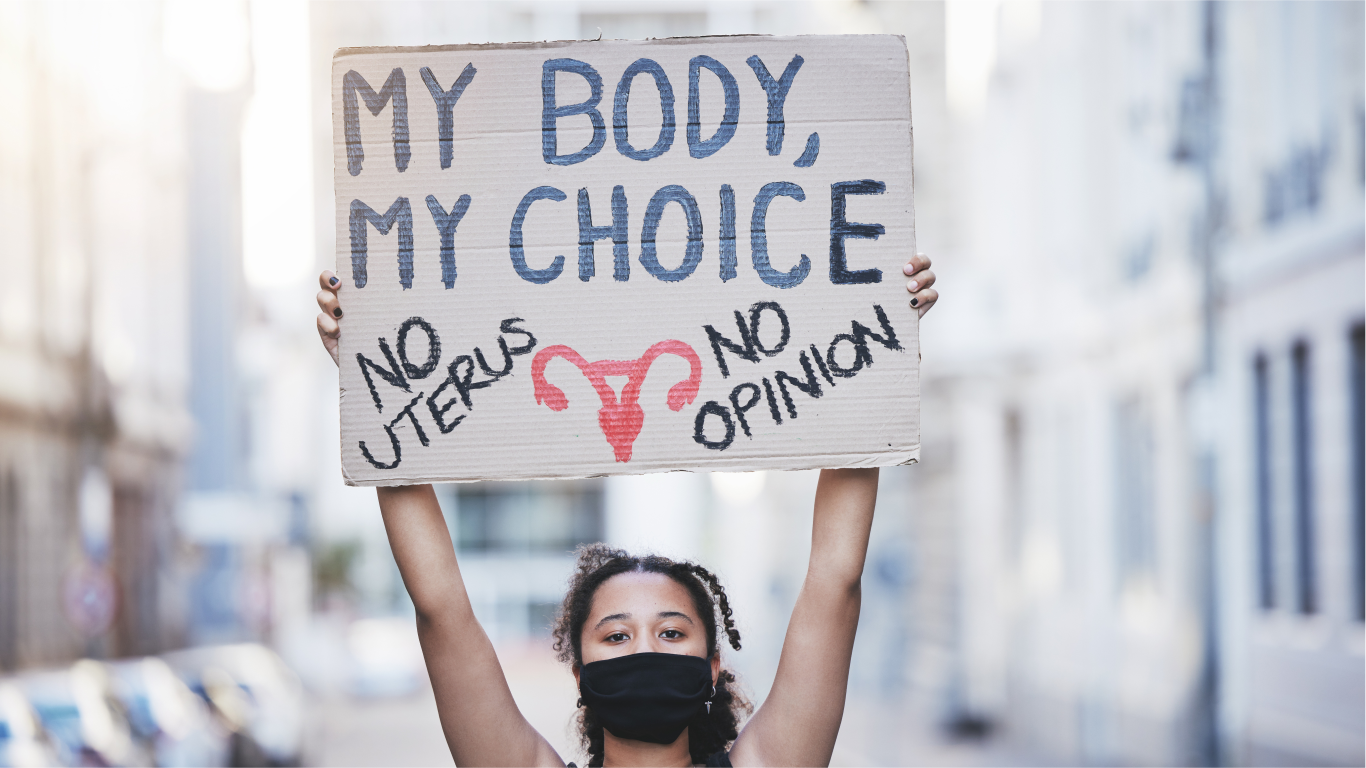
Abortion

What is the Privacy Rule? 

The lawsuit filed by Paxton challenges two rules set by HIPAA (Health Insurance Portability and Accountability Act of 1996): the 2000 Privacy Rule and the updated 2024 Privacy Rule. 

2000 Privacy Rule 

This rule, which became effective in 2001, should be familiar to anyone who’s been to the doctor and needed to fill out a bunch of forms. The law sets the national standards for the protection of individuals’ medical records and other personal health information. In other words, this is why, after the age of 18, other members of your family or close confidants need written permission from you to view your medical records.  

Other medical entities like healthcare providers and health plans may access the minimal necessary information about you as a patient to allow for convenient and high-quality treatment but its main goal is to safeguard patient privacy. Paxton’s lawsuit challenges the section that prevents disclosure of this information to state investigators/law enforcement without the individual’s authorization. 

2024 Privacy Rule 

The 2024 Privacy Rule, also called “the Final Rule”, makes an amendment to the original 2000 rule and was set as a response to the Supreme Court’s decision in Dobbs v. Jackson Women’s Health Organization, which overturned the federal right to abortion and led to state abortion bans and investigations across the country. The rule, made effective in June this year, prohibits state investigators from viewing the records of women who travel out of state to receive abortions in states where they are legal. The rule essentially protects the information of women in states where abortion is illegal, like Texas.  

In the lawsuit, Paxton claims that this is a violation of the original law that allows information to be revealed to states for law enforcement purposes. The lawsuit goes on to include “gender dysphoria” procedures in the term “Reproductive Health Care”, targeting transgender surgeries along with abortions. 

Abortion in Texas is considered illegal except in extreme cases where the mother is at risk of losing her life or is at great health risk because of the pregnancy. Women who seek or receive care will not suffer from criminal charges. Providers, on the other hand, could face losing their license and up to a life sentence in prison.  

Paxton asserts that the HHS has acted unlawfully, and that the federal government is “attempting to undermine Texas’s law enforcement capabilities”.  

What would it mean if Texas won? 

If Texas wins the lawsuit against the 2024 Privacy Rule, a few big things could happen: 

Stronger State Control Over Reproductive Laws and Overall 

At the base level, a victory for Texas would allow them access to medical records related to reproductive health, like abortion services and gender-transitions, for the purpose of potentially prosecuting individuals. That means less privacy and less protection for Texas patients. 

It would also mean a significant shift in state power in general. Since the inception of America, the fight over states’ rights versus federal rights has divided the country on who has the power. This lawsuit could affirm Texas’s ability to enact and enforce its own laws, especially regarding abortion and reproductive health. It might raise questions as to the validity of federal rules, like HIPAA. 

Weaker Federal Privacy Protections 

A ruling in favor of Texas would roll back the 2024 rule but it could also put the original HIPAA rules at risk as well. This could allow law enforcement and other state agencies to more easily access sensitive health information without the same safeguards required by the federal rule. As of now, an attestation must be signed by healthcare entities to ensure that medical records are not being used for prohibited purposes. It’s possible, though, that after the ruling, these things could be undermined. 

Confusion for Health Providers and Patients 

Like many policies in Texas, the ambiguity of the language and regulations leave those they are affecting in tough and confusing spots. Doctors and clinics may feel conflicted in having to follow federal rules that protect patient privacy and also state laws that might demand access to that same information. They could face legal consequences no matter which law they choose to follow. 

Additionally, patients who need an abortion but live in states where it is illegal, without the option of leaving the state to do it, might look for options that are unsafe and unregulated.  

In short, a win for Texas on this lawsuit would mean a loss for reproductive rights and for the American people. 

At Carter Law Group, we care about your rights. As defenders of women and sexual assault victims, as mothers, this subject hits close to our hearts. That’s why you can trust us to fight for your rights. If you’re in need of a lawyer, call us today.

Read similar articles below:

Civil Liabilities for Gun Violence in Schools

Texas Commission on Human Rights Act (TCHRA): What Is It And How Does It Affect Texas Employees?

Is the Supreme Court’s West Point Decision a Flower Amongst the Affirmative Action Rubble?

Share this entry
  • Share on Facebook
  • Share on X
  • Share on WhatsApp
  • Share on Pinterest
  • Share on LinkedIn
  • Share on Tumblr
  • Share on Vk
  • Share on Reddit
  • Share by Mail
https://clgtrial.com/wp-content/uploads/Blog-Post-Photos-10.png 768 1366 Amy Carter https://clgtrial.com/wp-content/uploads/2019/12/Carter-Law-Logo-Horizontal-.png Amy Carter2024-10-09 11:55:512024-11-19 12:11:35Texas Sues HIPPA For Protecting Abortion Medical Records

Categories

  • Child Safety
  • Consumer Product Safety Commission
  • Current Litigation
  • Dangerous Products
  • Employment Discrimination
  • Food Safety Recalls
  • Hair Relaxer Cancer Lawsuit
  • Legal Process 101
  • Mental Health
  • Our Small Business Journey
  • Personal Injury
  • Product Recalls
  • Recalls from FDA
  • School Safety
  • Sexual Assault
  • Sexual Harassment
  • Silicosis
  • This Is Fine: A COO Story
  • Uncategorized

Archives

  • April 2026
  • February 2026
  • January 2026
  • December 2025
  • November 2025
  • October 2025
  • September 2025
  • August 2025
  • July 2025
  • June 2025
  • May 2025
  • April 2025
  • March 2025
  • January 2025
  • December 2024
  • November 2024
  • October 2024
  • September 2024
  • July 2024
  • April 2024
  • February 2024
  • January 2024
  • December 2023
  • October 2023
  • June 2023
  • December 2022
  • November 2022
  • December 2021
  • October 2021
  • August 2021
  • July 2021
  • May 2021
  • January 2021
  • February 2020
  • October 2019
Carter Law Group logo

A fierce, female-owned plaintiffs’ firm with over 20 years of experience taking on catastrophic injury, sexual assault, and workplace discrimination—and winning.

Contact Us

351 W Jefferson Blvd Ste. 503, Dallas, TX 75208

Meetings by Appointment Only

Amy Carter, Managing Shareholder

214.390.4173

Heather Davis, Partner

214.390.4173

Hon. Erin Nowell, Partner

214.390.4173

Latest Posts

  • COO Cartoon dog in a burning office calmly holding a “You’re fired” mug while a laptop sends angry, profane messages, symbolizing setting boundaries in a chaotic environment.
    This Is Fine, A COO Story: Protecting the People Who Do the WorkApril 17, 2026 - 2:27 pm
  • What Counts as Corrective Action for Workplace Harassment in Texas in 2026?April 14, 2026 - 2:33 pm
  • Filing a Sexual Harassment Claim in Texas: Step-by-Step Guide for 2025April 6, 2026 - 11:21 am
  • This is Fine: A COO Story You're Too Emotional and Other BS People Tell You
    This is Fine: You’re “Too Emotional” (and Other BS People Tell You)February 20, 2026 - 1:24 pm
  • What Happens After You Call a Law Firm (And Why It Takes Time)January 13, 2026 - 6:22 pm
© 2026 All Rights Reserved | Privacy Policy | ADA Compliance
Link to: Knowing the Differences: Sexual Assault and Sexual Harassment Link to: Knowing the Differences: Sexual Assault and Sexual Harassment Knowing the Differences: Sexual Assault and Sexual Harassmentsexual assault and sexual harassment Link to: Commemorating the Wins and Losses of Hispanic Workers in History Link to: Commemorating the Wins and Losses of Hispanic Workers in History Hispanic workersCommemorating the Wins and Losses of Hispanic Workers in History
Scroll to top Scroll to top Scroll to top