


What to Do the Day You Get Fired in Texas (2026)
If you were just fired in Texas, here is what to do first. Don’t sign a severance agreement or release in the room. Find out when your final paycheck is coming, because state law gives your employer six calendar days to pay you after an involuntary termination. Apply for unemployment as soon as you can. And save the personal records you might need before your accounts get shut off. Texas is an at-will state, so an employer can let you go for almost any reason, with little notice and no explanation. That does not mean you have no rights. A few specific moves in the first hours and days protect your money and any claim you might have later.
We are Carter Law Group, a fierce, female-owned plaintiffs’ firm in Dallas, and we represent employees, not employers. We have tried four cases to verdict in the last two calendar years, and that shapes how we think about the days right after a termination.
Here is the short version:
- Stay calm in the meeting and sign nothing on the spot.
- Get clear on when your final paycheck is coming.
- Don’t delete, destroy, or take anything on your way out.
- Apply for unemployment right away.
- Save your pay stubs, reviews, and other personal records.
- Work out whether the firing might have been illegal, and put the deadlines on your calendar.
What to do (and what not to do) in the termination meeting
The meeting is short, and you are rattled. That is normal. Your job in that room is simple: stay civil, gather information, and avoid committing to anything.
Ask the practical questions. When will you get your final pay? What happens to your health insurance? Is there severance on the table, and can you take the paperwork home to read it? Those are all fair questions, and a reasonable employer will answer them.
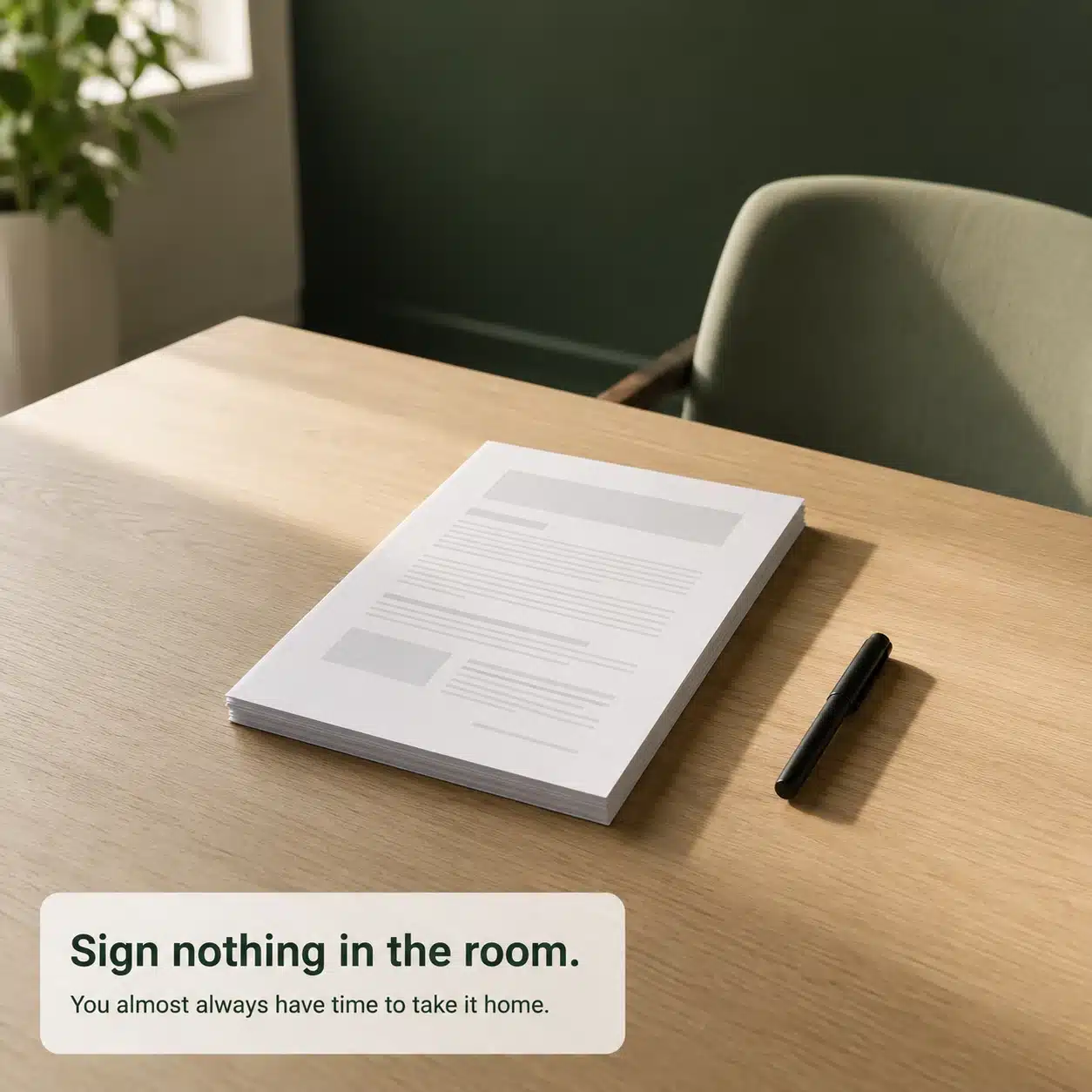
Then hold the line on signatures. If someone slides a severance agreement or a release across the table and asks you to sign before you walk out, don’t. You almost always have time, and signing a release can hand away your right to sue. More on that in a minute.
A few things to skip the day you get let go:
- Don’t sign the severance or release in the room.
- Don’t trash your employer online or in the group chat.
- Don’t delete or destroy emails, files, or messages from your work accounts.
- Don’t take proprietary company data like customer lists or trade secrets.
- Don’t make threats, and keep everything you say factual.
Venting feels good for about a minute. It can also become evidence. Keep your record clean.
How long does my employer have to pay my final paycheck in Texas?
If you were fired, your employer has six calendar days to pay you all of your earned wages. That is the Texas Payday Law, and the six-day clock runs on calendar days, weekends included. If you quit instead, the deadline is your next regular payday.
That final check has to cover everything you actually earned: salary, hourly pay, overtime, and commissions. Texas does not require your employer to pay out unused vacation or PTO, though, unless a written policy or contract promised it.
Your employer also can’t sit on your paycheck until you hand back a laptop or a badge. The six-day deadline holds either way. If your final wages don’t show up on time, you can file a wage claim with the Texas Workforce Commission within 180 days of the date the pay was due. The TWC lays out the process on its Texas Payday Law page.
Should I sign the severance agreement?
Not in the room, and usually not that week. Severance almost always comes attached to a release, which is a legal document that trades money for your promise not to sue. Before you sign, you want to know exactly what you are giving up.
Take the paperwork home. Read it slowly. If the numbers or the language don’t make sense, that alone is a good reason to have a lawyer look at it before you commit to anything.
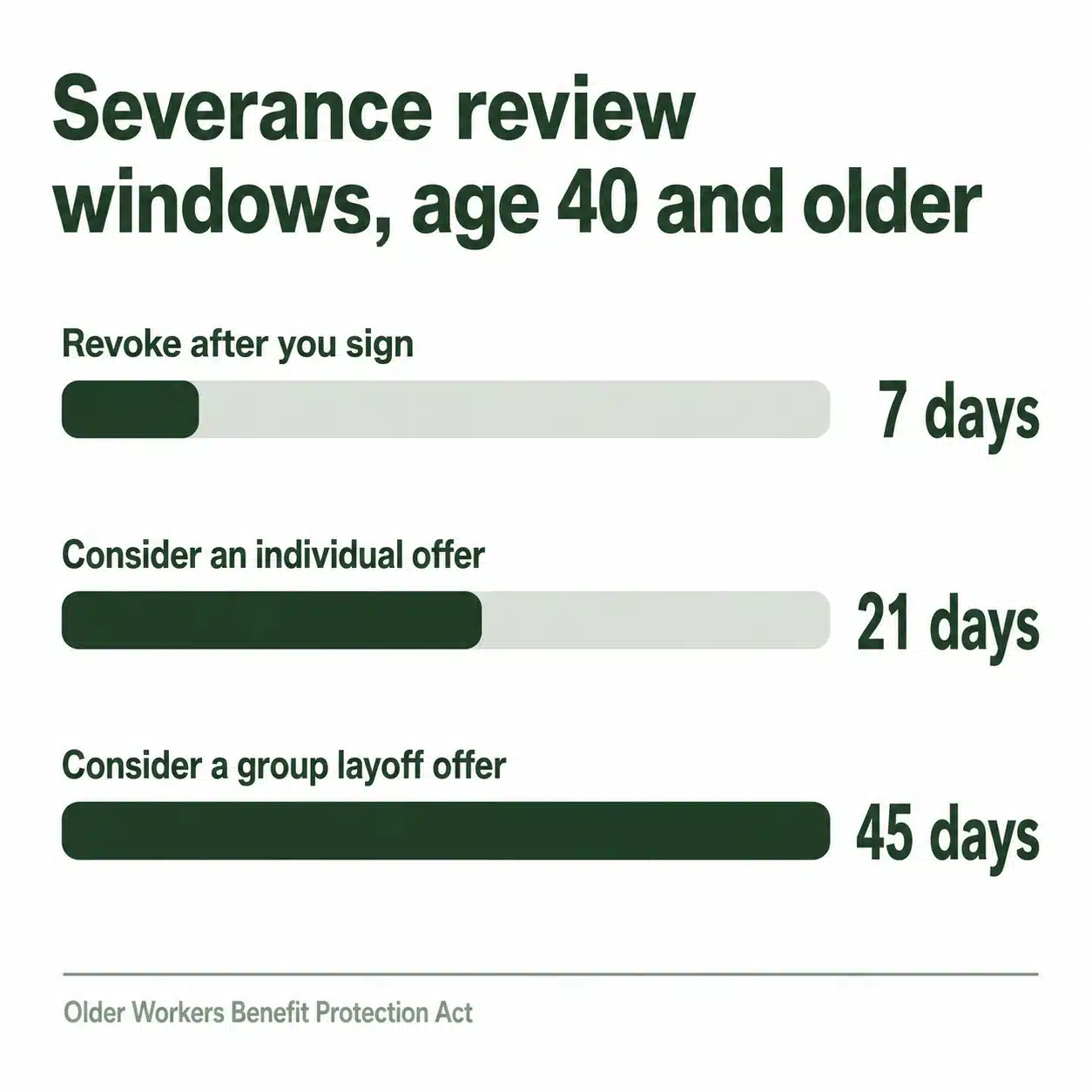
There is one place where federal law hands you a set amount of time, and it is narrower than most people assume. If you are 40 or older and the release asks you to waive age discrimination claims, the Older Workers Benefit Protection Act requires your employer to give you at least 21 days to consider the offer, or 45 days if it is part of a group layoff, plus 7 days to revoke after you sign. Those windows apply only to age-related waivers for workers 40 and up. They are not a right every fired worker gets. Younger workers, and releases that don’t touch age claims, get no automatic waiting period, though you can often negotiate for time.
This is where a plaintiff-side firm earns its keep. We negotiate severance, and when we do, we only take a fee on the amount we get you above the offer already on the table. If your employer handed you a number, treat that number as your floor. There are no consultation fees, no retainers, and no hourly billing. You can read how we handle these cases on our wrongful termination page or across the wider employment law section.
Can I get unemployment if I was fired in Texas?
Often, yes. Getting fired does not automatically disqualify you from unemployment benefits. The Texas Workforce Commission only turns you down when the discharge was for misconduct connected with the work, which means a serious policy violation, not an ordinary performance issue or a clash with your boss.
Apply as soon as you can through the TWC unemployment benefits system. Keep your Social Security number, your last employer’s details, the reason for the separation, and your wage history handy.
If the TWC denies your claim, you have a short window to push back. The appeal deadline is 14 calendar days from the date on your determination notice. Miss it, and the denial usually sticks. If you land there, our guide on how to appeal a denied unemployment claim in Texas walks through it step by step, and our unemployment lawyers in Dallas handle these appeals.
How do I know if my firing was illegal?
Start from the default. Texas is at-will, so most firings are legal even when they feel unfair. Your boss can fire you for a bad reason or for no reason at all. What your boss cannot do is fire you for a reason the law specifically forbids.
A firing may be illegal if it was based on:
- Discrimination tied to a protected trait, such as race, sex, pregnancy, age (40 and older), disability, national origin, or religion.
- Retaliation for protected activity, like reporting harassment, filing a workers’ comp claim, or raising a safety concern.
- Your refusal to break the law when your employer told you to. Texas recognizes this narrow public-policy exception.
If any of those fit your situation, you may have a discrimination, retaliation, or wrongful termination claim, and the clock starts running the day you are fired. To keep a discrimination claim alive, you generally have to file a charge with the Texas Workforce Commission’s Civil Rights Division within 180 days. The federal deadline through the Equal Employment Opportunity Commission runs longer, up to 300 days in Texas, because the state has a work-sharing agreement with the EEOC. You can check the federal rules on the EEOC’s time limits page. Filing with the TWC inside 180 days is the safe play, since it protects both the state and federal deadlines at once. Our explainer on filing a complaint with the EEOC and TWC covers how the dual-filing works.
Here is the honest part. Most employment lawyers in Texas will file the charge, run the administrative process, and settle for whatever the defendant offers in mediation. If the defendant won’t move, the case tends to die. We will let you know in the initial interview whether your case is one we think can be taken into litigation or not. And when we take your case into litigation, we build every case as though it will be tried, and defendants negotiate differently when they know the firm across the table is ready to put the case in front of a jury.
Save your records before you lose access
Texas does not give private employees any right to their personnel file. Once you are gone, you may never see it again. So pull together what you can while you still have access.
Worth downloading or copying:
- Recent pay stubs and your latest W-2.
- Your offer letter, employment contract, or any written promises.
- Benefits and insurance documents.
- Performance reviews, commendations, and positive written feedback.
- Contact information for coworkers who could be witnesses.
- Your own notes, or a timeline of what happened, written down while it is fresh.
Stick to your own records. Company property like client lists, internal databases, or trade secrets stays with the company, and taking it can create legal problems of its own.
What happens to your health insurance after you are fired
Losing the job often means losing the health plan the same day. Here is how to keep coverage.
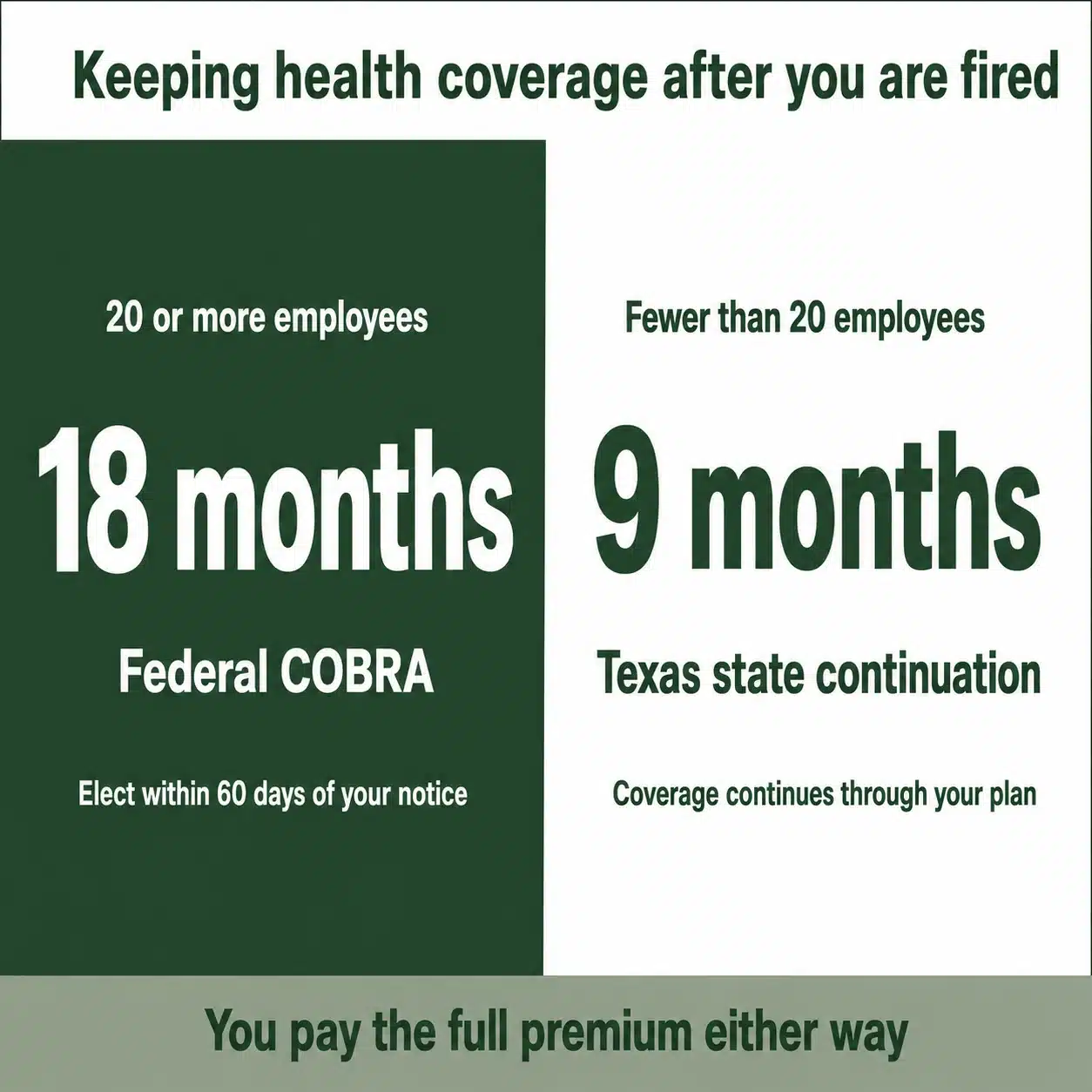
If your employer had 20 or more employees, federal COBRA lets you stay on the group health plan for up to 18 months. You get 60 days from the date of your COBRA notice to elect it, and you pay the full premium yourself. One catch: COBRA is off the table if you were fired for gross misconduct. The U.S. Department of Labor covers the basics on its COBRA continuation coverage page.
If your employer was too small for COBRA, meaning fewer than 20 employees, Texas state continuation can keep you covered for up to nine months. And if you burn through your 18 months of COBRA, Texas law allows up to six more months of continuation under many plans. In every version, the premium is on you.
What if you were part of a mass layoff?
Big layoffs come with their own rule. Under the federal Worker Adjustment and Retraining Notification (WARN) Act, employers with 100 or more employees generally have to give 60 days of written notice before a plant closing or a mass layoff that hits 50 or more workers at one site. Texas has no state mini-WARN law, so only the federal version applies. If your employer skipped the notice when it owed you one, you may have a claim. The Department of Labor’s plant closings overview spells out who is covered and how the notice works.
Texas deadlines to know after getting fired
A handful of dates matter more than the rest. Put these on your calendar the same week you are let go.
| What | Deadline |
|---|---|
| Final paycheck after an involuntary termination | Within 6 calendar days |
| File a wage claim for unpaid final wages | Within 180 days of the due date |
| Apply for unemployment | As soon as possible after termination |
| Appeal a denied unemployment claim | Within 14 calendar days of the determination |
| File a discrimination charge with the TWC | Within 180 days |
| File a discrimination charge with the EEOC (Texas) | Within 300 days |
| Elect COBRA continuation coverage | Within 60 days of your notice |
Frequently asked questions
Does my employer have to pay out my unused PTO in Texas?
No, not unless a written policy or contract promised it. On its own, Texas law does not require employers to pay unused vacation or PTO in the final check. If your handbook or agreement says you get it, that promise is enforceable.
Can my employer withhold my final paycheck until I return company property?
No. The six-day deadline for final pay after a firing still applies, even while you are holding a laptop, a phone, or keys. Give the property back, but your paycheck is not the ransom for it.
Am I entitled to my personnel file after being fired in Texas?
No. Private employees in Texas have no general right to inspect or get a copy of their personnel file. Grab copies of anything you need while you still have access to your accounts.
Is severance required in Texas?
No. Texas does not require employers to offer severance unless they agreed to it in writing. If severance was promised in a policy or a contract, though, it counts as wages and the employer has to honor it.
Talk to a Dallas employment lawyer before you sign anything
Getting fired is disorienting, and the pressure to sign the papers and just move on is real. You don’t have to make those calls alone or in a rush. If you were just let go, if there is a severance offer sitting in front of you, or if the firing looks like it was about something the law does not allow, we are glad to look at it with you.
At Carter Law Group, the consultation is free and there are no out-of-pocket costs. We only get paid if we win. Reach out through our meet with an attorney page and tell us what happened. Scheduling a call does not make us your lawyers yet, but it does get you a straight conversation about where you stand.


